 Call Us : 08045800070Call Us : 08045800070

 Send Inquiry
Rubber Hose for Conveying Concrete
MOQ : 50 Meters
Rubber Hose for Conveying Concrete Specification
- Resistance level
- Resistant to Abrasion, Weathering, and Chemicals
- Length
- Up to 20 meters or customized
- Tolerance
- ±1 mm
- Nitrogen Content (%)
- Nil
- Diameter
- 2 to 5 (50 mm to 127 mm)
- Feature
- Abrasion Resistant, Flexible, High Impact Resistance
- Weight
- Varies depending on size & length
- Width
- Customizable as per requirement
- Compression Ratio
- 5:1 (approximate)
- Tensile Strength
- 12~20 MPa
- Product Type
- Rubber Hose for Conveying Concrete
- Style
- Heavy Duty, Smooth or Corrugated Finish
- Part Type
- Hose Pipe
- Flame Resistance Level
- Standard Non-Flame Retardant (optional FR on request)
- Usage & Applications
- Used for conveying concrete in construction sites, tunnels, bridges, dams and other infrastructure projects
- Components
- Rubber Tube, Steel Wire Helix, Textile Reinforcement
- Size
- 2 to 5 (50 mm to 127 mm) ID available
- Density
- 1.25 Gram per cubic centimeter(g/cm3)
- Thickness
- 6 mm to 12 mm
- Water Absorption
- Negligible
- Color
- Black
- Material
- Natural Rubber with Reinforced Steel Wire Helix
- Surface Finish
- Smooth/Corrugated exterior as required
- Thermal Conductivity
- Low
- Hardness
- 65 ± 5 Shore A
- Natural Rubber
- High quality natural and synthetic rubber blend
- Rubber Type
- Natural/SBR Blend
- Temperature Resistance
- -40°C to +80°C
- Volatile Matter (%)
- Nil
- Ash %
- Nil (not applicable)
- Working Pressure
- Up to 40 Bar
- Outer Cover
- Weather and abrasion resistant rubber
- Minimum Bending Radius
- 6x hose ID
- Ozone Resistance
- Excellent
- End Connection
- Available with plain, flanged, or coupling ends
- Applications
- Ideal for transit mixer, concrete pump, shotcrete, and mortar conveying
- Packaging Type
- Coil or as specified
- Reinforcement Layer
- High tensile synthetic textile and steel wire helix
- Burst Pressure
- Minimum 60 Bar
- Inner Tube
- Black smooth synthetic/Natural rubber, highly abrasion-resistant
- Standard Conformance
- IS: 1307 / EN 12001 / As per customer specification
Rubber Hose for Conveying Concrete Trade Information
- Minimum Order Quantity
- 50 Meters
- Supply Ability
- Meter
- Delivery Time
- 1 Week
Rubber Hose for Conveying Concrete About
Rubber Hose for Conveying Concrete
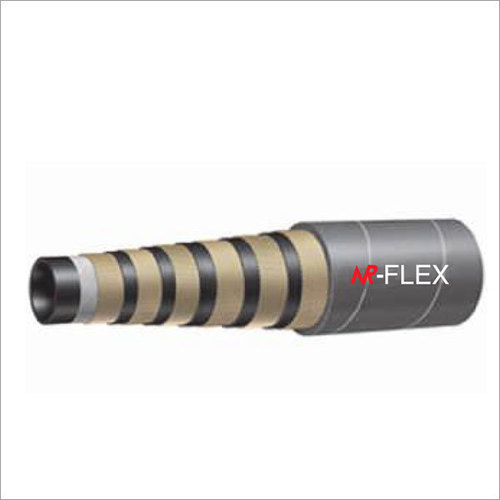
CONSTRUCTION: Involves three layers: inner tuber, reinforcement layer, outer layer.
CATEGORY:
- Cord plies as reinforcement layer
- Wire ropes and cord ply as reinforcement layer
- Wire ropes (or wire) as reinforcement layer
- Wire ropes (or wire) as reinforcement layer
APPLICATION AND TEMPERATURE RANGE: Conveying concrete, mud under positive or negative pressure in the ambient temperature of -30 CC to 70 CC. |
FEATURE: We can manufacture hoses of different reinforcement, different working pressure, and different weight.
Specification
| Hose ID | Working pressure | Test Pressure | Burst Pressure | ||||
| Inch | mm | BAR | PSI | BAR | PSI | BAR | PSI |
| 5 | 127 | 85 | 1232 | 127.5 | 1850 | 212.5 | 3080 |
Engineered for Demanding Construction Applications
Designed specifically for the transmission of concrete, the hose withstands rigorous demands in diverse environments such as tunnels, bridges, dams, and high-rise sites. With a minimum burst pressure of 60 bar and working pressure up to 40 bar, it assures both safety and performance for challenging projects.
Superior Durability and Flexibility
Constructed with a unique high tensile textile and steel wire reinforcement, the hose ensures a dependable compression ratio and high impact resistance. Its synthetic/natural rubber blend resists abrasion, weather-induced degradation, and chemical exposure, while permitting a minimum bending radius as low as 6 times the hoses inner diameter.
Customizable to Project Needs
Available in both smooth and corrugated finishes, with inside diameters ranging from 50 mm to 127 mm and lengths up to 20 meters, this hose can be tailored to specific site requirements. Choices of end connectionsplain, flanged, or couplingenhance adaptability for varied construction systems.
FAQs of Rubber Hose for Conveying Concrete:
Q: How is this rubber hose used for concrete conveying in construction projects?
A: The hose is attached to concrete pumps or transit mixers, enabling the safe and efficient transfer of concrete to specific areas such as building foundations, tunnels, or bridge decks. Its abrasion-resistant inner layer allows for continuous operation, even with materials containing coarse aggregates.Q: What sets this concrete conveying hose apart in terms of resistance and durability?
A: This hose offers excellent abrasion, ozone, weather, and chemical resistance due to its natural and synthetic rubber blend, reinforced with high tensile textile and a steel wire helix. Its robust construction delivers a minimum burst pressure of 60 bar and reliable tensile strength, suitable for rigorous on-site conditions.Q: When should I opt for a smooth versus a corrugated hose finish?
A: Smooth finishes are ideal for lower drag and easier cleaning, commonly used for straight runs or automated systems. Corrugated exteriors offer greater flexibility, making them suitable for installations requiring frequent bending or around obstacles at construction sites.Q: Where is this hose most commonly applied in infrastructure projects?
A: The hose is widely used in construction sites, tunnels, bridge building, dam projects, and any application where concrete must be precisely delivered under pressure and through challenging environments.Q: What is the process for selecting the right hose size and end connection?
A: Identify the required inner diameter (between 2 to 5 inches), preferred length (up to 20 meters), and end connection typeplain, flanged, or couplingbased on the equipment and site requirements. You may also consider working pressure, bending radius, and abrasion demands for optimal compatibility.Q: What benefits does using this hose offer for concrete pumping operations?
A: Users benefit from high flexibility, abrasion and weather resistance, dependable pressure ratings, and customizable dimensions. These features enhance operational safety, reduce downtime, and support efficient, trouble-free delivery of concrete on complex sites.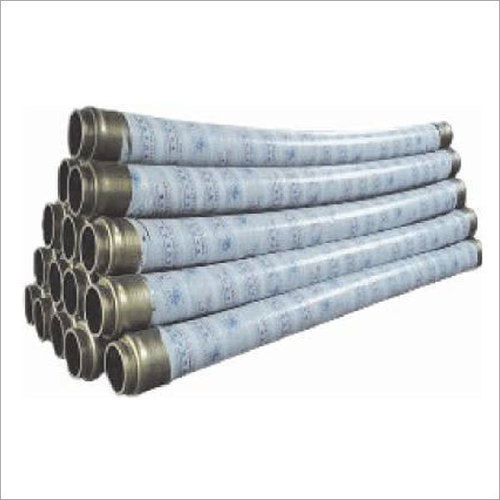
Tell us about your requirement

Price:
Quantity
Select Unit
- 50
- 100
- 200
- 250
- 500
- 1000+
Additional detail
Mobile number
Email

More Products in Rubber Hose Category
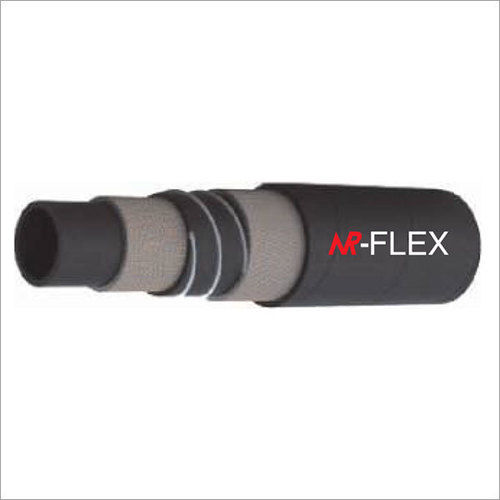
Air & Water Suction Hose
Minimum Order Quantity : 50 Meters
Feature : Flexible, Abrasion Resistant, Lightweight, Durable
Diameter : 50 mm to 300 mm (as per size selection)
Length : Available in 3, 6, 15, or 30 meters standard lengths
Resistance level : High resistance to weather, ozone, and abrasion
Part Type : Hose Pipe
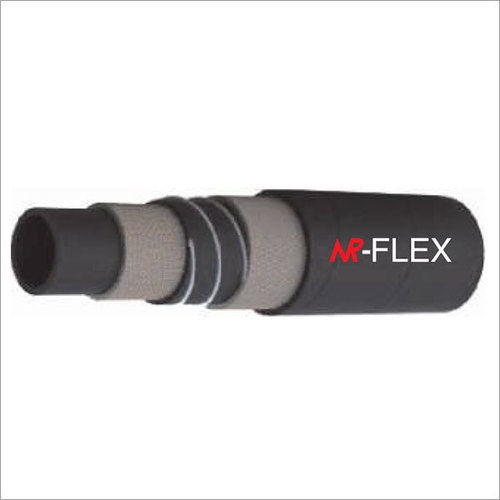
Oil Suction Hose
Minimum Order Quantity : 50 Meters
Feature : Flexible, abrasionresistant and weatherproof
Diameter : 50 mm to 200 mm
Length : Standard length 7.5 m or 15 m; custom lengths available
Resistance level : Resistant to oil, weather, mild chemicals
Part Type : Suction/Delivery Hose
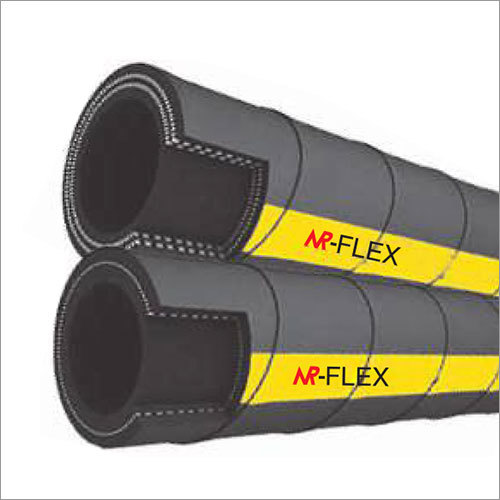
Water Rubber Hose
Minimum Order Quantity : 50 Meters
Feature : Durable, Leakproof, Smooth finish
Diameter : 50 mm to 150 mm
Length : 10 m to 30 m
Resistance level : Abrasion, weather, and mild chemical resistant
Part Type : Hose Pipe
Synthetic Rubber + Wire Braid Hydraulic Hose
Minimum Order Quantity : 50 Meters
Feature : High flexibility, leakproof, abrasion resistant, weather resistant
Diameter : 6.4 mm to 50.8 mm (Internal Diameter) Millimeter (mm)
Length : Up to 100 meters (customized lengths available) Meter (m)
Resistance level : High Pressure, Corrosion & Abrasion Resistant
Part Type : Hydraulic Hose

"We accept inquiries only for bulk orders."
Address
GST : 08AAHPJ8821H1ZK
- F-49/50, RIICO INDUSTRIAL AREA CHOPANKI, BHIWADI,Alwar - 301019, Rajasthan, India
- Phone :08045800070
- Send Inquiry
 Send Inquiry
 Send Inquiry
 Send SMS
 |
NATIONAL RUBBER INDUSTRIES
All Rights Reserved.(Terms of Use) Developed and Managed by Infocom Network Private Limited. |
